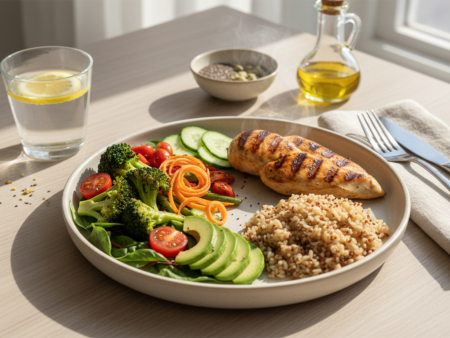
Energy intake should cover individual energy expenditure based on body weight, body type, physical activity, and overall health. Children need additional energy for growth, pregnant women need it for tissue storage, and nursing mothers need it for milk production.
Daily energy expenditure consists of the following components:
- Basal metabolic rate (BMR), which is the energy expenditure at rest, or basal energy expenditure, needed for respiration, heart function, maintaining body temperature, and other vital functions.
- Digestive and assimilation energy expenditure is the amount of energy needed to digest food and absorb the nutrients it contains.
- Activity-related energy expenditure
Energy expenditure is measured in kilojoules [kJ] (1 kJ = 0.24 kcal; 1 kcal = 4.184 kJ). In Estonia, kilocalories are predominantly used for energy value calculations and recommendations.

On average, energy expenditure is higher in men than in women. This is primarily due to differences in height and body composition between the sexes. Based on physical activity level (PAL), the actual energy requirements of two people of the same sex, age, and body size can vary significantly.
- PAL 1.4 – sedentary work, minimal physical activity in free time
- PAL 1.6 – sedentary work with light physical activity, minimal physical activity in free time
- PAL 1.8 – work requiring both standing and active movement, with high physical activity in free time
The vast majority of people have a physical activity level of 1.4; for those who are more active, it’s 1.6. Only a few (those particularly active in sports) reach a level of 1.8.
Energy expenditure (primarily PAV) is increased or decreased by the following factors:
- Cold or hot environment, genetic factors,
- hormonal status (e.g., thyroid and growth hormone levels in the blood),
- sympathetic nervous system activity,
- psychological environment,
- medication intake, and
- many medical conditions.
Basal metabolic rate (BMR)
Basal metabolic expenditure (BME) is an individual’s energy expenditure during complete mental and physical rest in a thermally neutral environment 12 hours after the last meal. Resting energy expenditure, measured under milder conditions than BME, is typically 5 percent higher. Average energy expenditure decreases during sleep: BME during sleep is 10 percent lower than BME during wakefulness. Despite minor systematic differences, energy expenditure during sleep, BME, and resting energy expenditure are highly correlated, and these concepts are often used synonymously.
Daily energy expenditure is highly dependent on body mass, and in particular, lean (fat-free) body mass. Fat mass is positively associated with energy expenditure, although energy expenditure per unit of fat mass is significantly lower than energy expenditure per unit of lean body mass. Therefore, individual differences in energy expenditure between two individuals of the same weight are better explained by lean mass than by fat mass. Lean mass includes the mass of skeletal muscle and organs. The basal metabolic rate (BMR) per kilogram of organs is much higher than that of skeletal muscle. In adults, the BMR of organs accounts for 70–80% of resting energy expenditure, but organs themselves account for only 5% of body mass. Therefore, higher lean mass has a greater impact on BMR, while skeletal muscle plays a minor role in BMR.
Individual lean body energy expenditure varies by approximately 2.1 MJ (approximately 500 kcal) per day, which characterizes the magnitude of differences in BMR at the same lean body mass. The main factors that influence differences in BMR are individual genetic makeup, body composition, hormone levels, energy balance, and physical fitness.
Energy expenditure on digestion and assimilation of food
Energy expenditure required for digestion and absorption of food increases after a meal and depends on the composition of the meal. After a meal, energy expenditure increases for several hours, but mostly (up to 90%) within four hours after eating. Energy expenditure on digestion and absorption of food in people eating a balanced, mixed diet typically accounts for 10% of daily energy expenditure on average, with approximately 5% of energy coming from protein and approximately 20% coming from fat. When consuming carbohydrates, energy expenditure on digestion and absorption of food accounts for 10%, but this figure can increase to 20% with excess glucose consumption, when this excess is used to produce fat.
Energy expenditure associated with physical activity
Physical activity is any bodily movement performed by skeletal muscles that requires additional energy expenditure compared to the basal metabolic rate. Physical activity is a subset of physical activity that represents voluntary actions that positively impact physical, psychological, and social well-being.
Physical activity level (PAL) is the total energy expenditure above the basal metabolic rate (BMR), which characterizes the body’s total daily energy expenditure. This level of physical activity is determined by daily energy expenditure and body weight.
Metabolism equivalent (MET) is the energy expenditure during any activity above the BMR. It depends on the physical activity performed throughout the day and the time spent on various activities. Each activity has its own MET value, and to calculate daily energy expenditure, the time spent on various activities must be calculated.
Daily energy expenditure on physical activity is divided between work-related activities and recreational activities. The latter, in turn, is divided into physical and non-physical activities of varying intensity. Work-related activities can also vary in intensity. Physical inactivity is defined as a state in which energy expenditure is close to the basal metabolic rate. Such states typically include sitting and lying down while awake.
Calculating the Energy Value of Food
The energy contained in food is made available through metabolism. The nutritional value of a food is determined in the laboratory by measuring the amount of heat released by its organic components through oxidation. Since the energy value and digestibility of macronutrients vary from food to food, for mixed foods, it is convenient to use standardized average values of the energy value and digestibility of food macronutrients.
The nutritional recommendations adopted in Estonia are based on the following energy values:
- 1 g protein = 4 kcal, i.e. 17 kJ
- 1 g fat = 9 kcal, i.e. 37 kJ
- 1 g carbohydrates = 4 kcal (1 g dietary fiber = 2 kcal), i.e. 17 kJ
- 1 g pure alcohol (which is not an essential nutrient for the body) = 7 kcal, i.e. 29 kJ
As is already known, not all energy consumed with food is used to meet the body’s energy needs. The available energy of various macronutrients varies greatly because their metabolism itself requires different amounts of energy. Furthermore, there are significant differences in individual absorption of macronutrients depending on the specific food consumed, its preparation method, and intestinal factors.
Energy Requirements
The assessment of energy requirements for adults is based on resting energy expenditure (RAV) and physical activity level (PAL). When assessing energy requirements for adults in Nordic countries, it is recommended to use body weight, which corresponds to a body mass index of 23, taking into account individual height. Recommended energy requirements are based on normal (healthy) body weight, its stability, and energy balance. However, they do not apply in cases of negative or positive body weight balance.
Average daily energy requirements for adults (kcal/day) for various physical activity levels.
| Age | RMR1 Approximate Basal Metabolic Rate, kcal/day | Sedentary Lifestyle PAL2 1.4, kcal/day | Moderate Activity PAL2 1.6, kcal/day | Active Lifestyle PAL2 1.8, kcal/day |
|---|---|---|---|---|
| Women (62.5±2.5 kg) | ||||
| 18–24 years | 1400 | 2000 | 2250 | 2550 |
| 25–50 years | 1350 | 1900 | 2150 | 2450 |
| 51–70 years | 1350 | 1700 | 2000 | 2200 |
| >70 years | 1200 | 1700 | 1950 | 2200 |
| Pregnant Women3 | 1550 | 2100 | 2450 | 2750 |
| Breastfeeding Mothers | 1850 | 2600 | 3000 | 3350 |
| Age | RMR1 Approximate Basal Metabolic Rate, kcal/day | Sedentary Lifestyle PAL2 1.4, kcal/day | Moderate Activity PAL2 1.6, kcal/day | Active Lifestyle PAL2 1.8, kcal/day |
|---|---|---|---|---|
| Men (72.5±2.5 kg) | ||||
| 18–24 years | 1750 | 2500 | 2800 | 3150 |
| 25–50 years | 1700 | 2350 | 2700 | 3050 |
| 51–70 years | 1550 | 2150 | 2450 | 2750 |
| >70 years | 1500 | 2100 | 2400 | 2700 |
PAV – basal metabolic rate
PAL – physical activity level
Full breastfeeding of the baby for 0–6 months after birth.